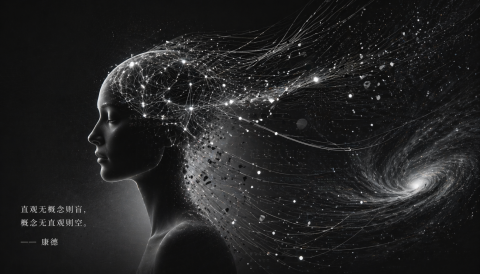
Viewed through the lens of the philosophy of science, the fundamental paradox of current Large Language Models (LLMs) represents a modern resurrection of Hume’s Problem: pure statistical induction (frequency and probability) can never deduce logical necessity (causality and truth). An LLM is neither a sterile statistical black box nor a flawless Platonic realm of forms. Rather, it is a dynamic system—a rugged topological landscape violently compressed from empirical data, where localized probabilistic cascades occur under the temporary distortion of context, urgently requiring external logical validators to establish rigid boundaries.
The Geometric Dynamics of Silicon Cognition: A General Relativity and Artificial Epistemology of Large Language Models